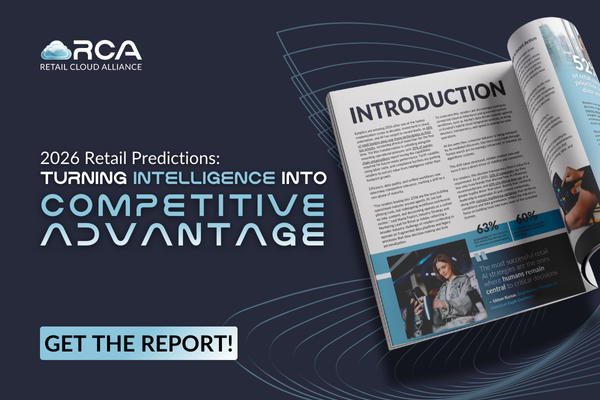
We’ve officially surpassed the era of expansion, which was defined by the speed and agility of adapting to market changes and implementing the most appropriate AI-driven tools. Now, we enter the age of intelligence; where informed action determines growth. As AI, automation, and real-time data become foundational, competitive advantage is no longer driven by adoption alone, but by how effectively intelligence is governed, connected, and operationalized across the enterprise.
This report explores how leading retailers are transforming intelligence into measurable performance; balancing trust, agility, and execution to navigate uncertainty and scale sustainably in 2026 and beyond.
Access the Full Report
Adoption is over. Advantage is earned.
AI adoption is no longer a differentiator; it’s the baseline. The retailers poised to pull ahead in 2026 are those prepared to govern intelligence, connect fragmented systems, and turn insight into coordinated action across the enterprise. This report examines the operational, architectural, and trust-driven shifts required to achieve this approach, converting intelligence into sustained competitive advantage.
Key Takeaways
Trust Becomes Infrastructure
Transparency, explainable AI, and governance are no longer optional. Trust is emerging as a strategic KPI that directly influences loyalty, conversion, and brand resilience.
Digital twins, AI-based planning, and store-edge intelligence are enabling retailers to anticipate disruption rather than respond after the fact.
From Insight to Instant Action
Retailers are shifting from insight-driven analysis to action-driven ecosystems, where real-time data activates pricing, inventory, labor, and experience decisions instantly.
Unified Commerce Becomes the Operating Model
Siloed omnichannel strategies are giving way to unified commerce architectures, connecting data, content, and execution across every customer and operational touchpoint.
Meet the Contributors
This report brings together perspectives from senior leaders across retail, technology, operations, and academia—offering a well-rounded view of how intelligence is reshaping retail performance in 2026.
Marta Frattini
Industry Strategy & Marketing Lead, Retail — Adobe
Marta focuses on enterprise retail transformation, AI-driven content workflows, and governed intelligence at scale. Her work centers on helping retailers operationalize AI responsibly while accelerating personalization and decision-making.
Uttam Kumar
Engineering Manager — American Eagle Outfitters
Uttam brings a practitioner’s perspective on human-centered AI, operational maturity, and the role of intelligence in modern retail workflows and decision systems.
Shannon Kirk Nakamoto
Senior Director, Legal Industry Advisory — Icertis
Shannon specializes in contract intelligence, compliance automation, and embedding trust and governance into enterprise operations—critical capabilities as AI scales across retail ecosystems.
Mark Propes
Chief Business Development Officer — VusionGroup
Mark focuses on store-edge intelligence, connected shelf environments, and the role of real-time data in driving operational resilience and execution at the physical retail edge.
Brandon Rael
Director & Consult Partner — Kyndryl
Brandon advises global retailers on intelligent automation, infrastructure resilience, and scaling AI securely across hybrid-cloud and mission-critical environments.
Mina Fader
Managing Director — Wharton School, Baker Retailing Center
Mina brings an academic and strategic lens to retail transformation, with expertise in organizational efficiency, human-centered automation, and sustainable operational design.
Greg C. Merrill
President — Futura Fagua
Greg specializes in unified commerce strategy, enterprise data alignment, and breaking down system silos to enable faster, more accurate retail decision-making.