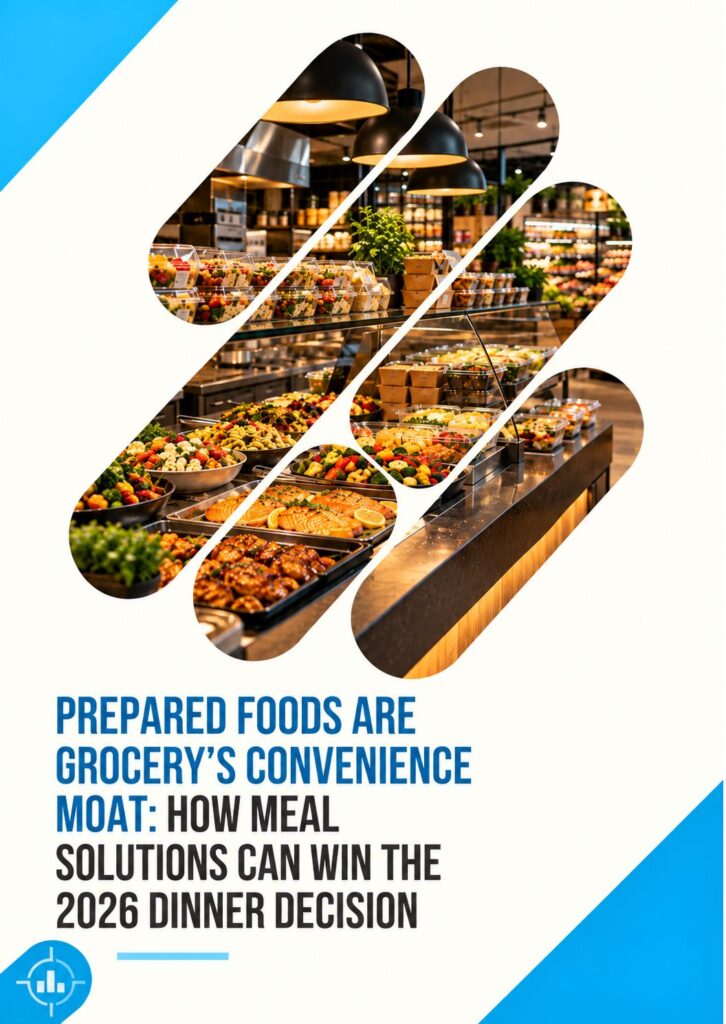
The most important competitor for a grocery prepared-food department may not be another supermarket. It may be the restaurant app on a customer’s phone.
That changes how executives should think about foodservice. Prepared foods are not merely incremental assortment. They are a way to compete for the household’s most time-sensitive question: what are we eating tonight?
FMI’s 2026 industry research points to continued retailer emphasis on foodservice and prepared foods. The strategic reason is compelling. Grocery already owns ingredients, traffic, replenishment, and household trust. Prepared food can turn those assets into a convenience proposition.
From Department to Meal Mission
Traditional category management starts with products. Meal-solution management starts with occasions.
Weeknight dinner, lunch, after-school food, family gatherings, breakfast, game day, and healthy convenience have different needs. Each requires decisions about portion, price, packaging, freshness window, production timing, cross-merchandising, pickup, and availability.
The executive question is not “How large should the deli be?” It is “Which meal missions can we serve better than the alternatives?”
The Convenience Moat
Restaurants offer immediacy. Meal kits offer planning support. Convenience stores offer speed. Grocery can combine breadth, household replenishment, fresh credibility, and one-trip economics.
The moat appears when the retailer makes the meal easier: a prepared entrée plus sides, a rotisserie solution plus produce, a lunch bundle, or a recipe that can be purchased as a complete basket.
This is a systems problem as much as a culinary one.
The Economics Need a Different Dashboard
Prepared food can carry attractive revenue, but the economics are sensitive to labor and waste.
Executives should track:
Demand by daypart and location.
Production forecast accuracy.
Labor minutes per unit or meal.
Waste and markdown by item.
Ingredient reuse across menu architecture.
Availability at peak demand.
Attachment to broader baskets.
Repeat purchase.
Contribution after labor, packaging, and waste.
A sales-only dashboard can hide an expensive operating model.
Digital Extends the Counter
Prepared foods should be discoverable before the customer enters the store. Search, app merchandising, meal planning, recipes, and personalized recommendations can make the offer visible during the planning moment.
The critical requirement is accuracy. Promoting a meal that is unavailable creates more frustration than value. Digital prepared-food growth therefore depends on better item data, local availability, production visibility, and substitution logic.
Fresh and Prepared Foods Reinforce Each Other
Prepared foods can showcase the retailer’s fresh quality. Fresh departments can supply ingredients, seasonal relevance, and culinary credibility.
The strongest operating models will coordinate procurement, production, merchandising, and waste across those departments rather than manage each as a silo.
A Five-Part Prepared Foods Operating Model
- Mission: Which customer occasion are we solving?
- Menu: What repeatable architecture balances variety with production discipline?
- Production: When and where is food prepared, replenished, and marked down?
- Promise: What freshness, availability, speed, and quality should the customer expect?
- Economics: What labor, waste, packaging, and margin guardrails must hold?
What Leaders Should Avoid
Avoid menu sprawl that creates operational complexity.
Avoid copying restaurant assortment without restaurant-grade production discipline.
Avoid digital promotion without local availability.
Avoid measuring only gross margin without labor and waste.
Avoid treating food safety, quality, and speed as separate programs.
Why This Matters in 2026
As shoppers redefine value around time as well as price, prepared foods can make the grocery trip more relevant. They also create differentiation that pure price competition cannot easily replicate.
The State of Grocery Retail 2026 report places this opportunity within a wider set of category shifts.
View the report:
Conclusion
Prepared foods become strategic when grocery stops treating them as a department and starts managing them as a meal-solution business. The advantage comes from connecting culinary relevance with production discipline, digital discovery, fresh trust, and transparent economics.
References
- FMI, The Food Retailing Industry Speaks 2026.
- FMI, 2026 research and resources on foodservice/prepared foods.
- RETHINK Retail / Intent Amplify, State of Grocery Retail 2026.