or call: +1-602-898-6394


or call: +1-602-898-6394
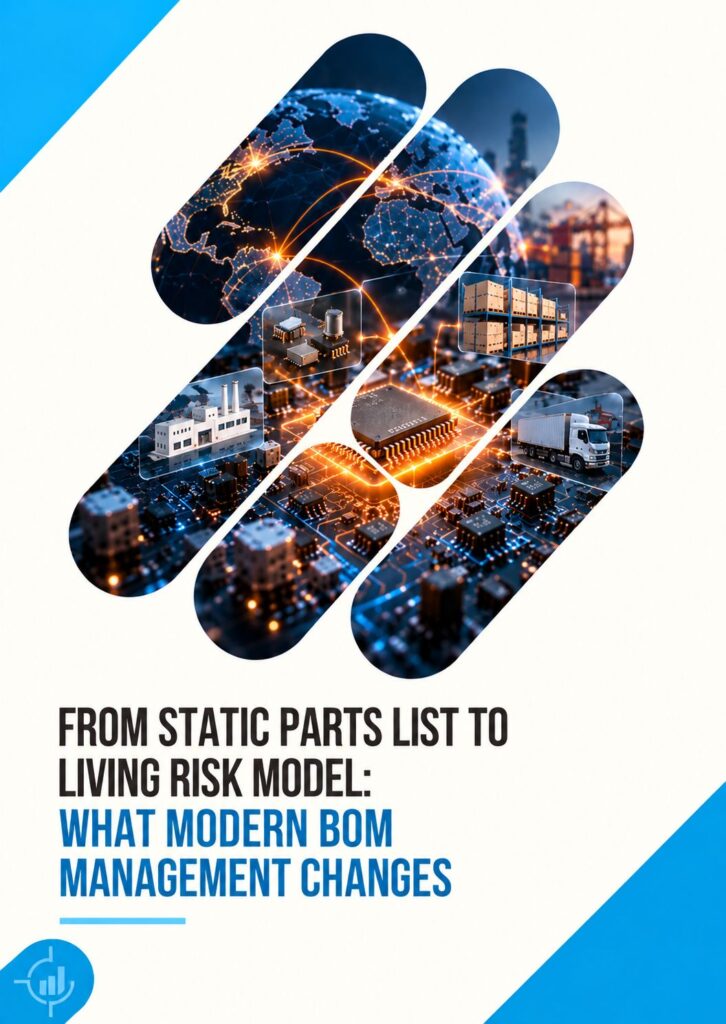
For decades, the bill of materials has been treated as a record of what a product needs to be built. That definition is no longer sufficient for electronics organizations operating in a component market where availability, lifecycle status, lead times, supplier conditions, compliance requirements, and commercial exposure can change long after a design decision is made.
A BOM can be technically correct and operationally fragile at the same time.
That distinction is why modern BOM management is moving beyond static files. The emerging model treats the BOM as a living risk surface: a shared operating object that engineering and procurement can use to identify exposure, evaluate alternatives, and act while the design is still flexible.
Altium’s supply-chain resilience whitepaper makes this shift explicit. It describes why electronics companies are moving beyond spreadsheets toward dedicated BOM management to strengthen resilience, reduce fragmented work, and improve the connection between engineering and procurement [1].
The important change is not the file format. It is the decision model around the BOM.
Spreadsheets remain useful because they are familiar, flexible, and easy to exchange. The problem begins when a spreadsheet becomes the primary operating system for component risk.
A static BOM captures a point in time. Supply conditions do not stay at that point.
A component that was available during schematic design may later face a lifecycle change. A qualified part may remain technically acceptable while its lead time no longer fits the production plan. An alternate may exist, but no one may have documented whether engineering has approved it. Procurement may discover a constraint only after the design is mature, when changing the part carries more schedule and validation cost.
DigiKey’s 2026 supply-chain analysis argues that greater stability should not be confused with predictability and that electronics OEMs need supply chains designed to absorb shocks and reallocate resources rapidly [2]. For BOM teams, that makes the operating requirement clear: current component context must be reviewed while engineering choices are still flexible, not only after a sourcing exception reaches procurement.
That is the core weakness of the static model. It does not automatically preserve the relationship between the part, the latest supply signal, the product affected, the available alternatives, and the decision owner.
Modern BOM management changes the question from “What parts are on the list?” to “What does the current state of these parts mean for our ability to build?”
That requires several types of context to remain connected.
Engineering context explains why a component was selected and what technical constraints an alternate must satisfy. Procurement context shows whether the part can be sourced under the required timing and commercial conditions. Lifecycle context helps teams understand whether a component is moving toward obsolescence. Portfolio context shows where the same part appears across multiple products. Decision context records what the team reviewed and what action was approved.
When these views are fragmented across spreadsheets, email, supplier portals, and local files, teams spend time reconstructing context before they can act.
Altium describes BOM Portal as a workspace with live supply-chain intelligence, alternative-part recommendations, and collaborative review tools designed to help teams turn BOMs into production-ready assets [3]. The value of that model is not simply greater visibility. It is that visibility becomes attached to a workflow where engineering and procurement can evaluate the same component in the same product context.
A static process tends to create periodic checkpoints. The BOM is reviewed before release, before a build, or when procurement encounters a problem.
A living-risk model is different. It assumes that the environment around the BOM continues to change and that risk should be revisited when meaningful signals change.
That does not mean every market movement should trigger an engineering escalation. The objective is to separate background noise from changes that can affect a product decision.
A practical operating model asks four questions.
This is why shared BOM intelligence matters. It shortens the distance between detecting a signal and reaching an accountable decision.
Broad market conditions can improve while individual BOMs remain exposed.
ECIA’s August and Q3 2026 Industry Pulse reported an overall component sentiment index of 136.7, down 17.4 points from its June peak but still above the levels seen through much of the preceding 4.5 years. The same Industry Pulse program tracks product lead times, cancellations, decommits, sales expectations, and multiple component categories and end markets [4].
For engineering leaders, the lesson is not that the market is either “good” or “bad.” It is that aggregate market direction cannot answer whether a specific part is appropriate for a specific product.
BOM resilience therefore depends on component-level judgment supported by current context. A healthy market does not remove single-source risk. Strong demand does not make every alternate technically acceptable. Improving availability does not resolve a lifecycle issue.
A living BOM helps teams keep those distinctions visible.
Traditional handoffs encourage sequential responsibility. Engineering selects and releases. Procurement sources. Manufacturing executes. When a component problem appears, the issue travels backward through the chain.
That model becomes expensive when the problem could have been addressed earlier.
A more resilient model makes component risk a shared decision before release. Engineering remains responsible for technical suitability. Procurement contributes current sourcing and market context. The BOM becomes the place where those views meet.
Mouser’s 2026 procurement guidance similarly frames electronics sourcing as a strategic discipline shaped by shortages, supplier relationships, delivery timing, flexibility, and digital tools rather than price alone [5]. In a living BOM model, that commercial context becomes part of the decision process instead of a downstream purchasing check.
The operating principle is simple: move the conversation upstream while choices are still inexpensive.
Teams do not need to transform every process at once. A useful starting framework is to establish six disciplines around one commercially important BOM.
This framework turns the BOM from a document into a repeatable operating mechanism.
Altium BOM Portal is relevant to this transition because it is designed around the BOM as a shared, continuously informed workspace rather than a static spreadsheet handoff.
The campaign’s underlying argument is practical: electronics teams need a dedicated way to bring supply-chain context closer to engineering decisions, improve collaboration with procurement, evaluate component risk, and manage alternatives before disruptions force reactive work.
For organizations considering a move away from spreadsheet-centric BOM management, the decision should be based on workflow evidence.
How many copies of a BOM exist during a normal release? How often does procurement need to reconstruct engineering context? When a risky component is identified, how long does it take to reach an approved action? Are alternates evaluated before a shortage or only during one? Can teams identify which products use an exposed component without manually reconciling files?
Those questions reveal whether the current process is merely documenting the BOM or actively managing its risk.
Download the Altium whitepaper, Building Supply Chain Resilience: Transforming BOM Management for Modern Electronics, to evaluate when a dedicated BOM-management model becomes more appropriate than spreadsheet-led coordination.
A living BOM is a bill of materials managed as a continuously informed operational asset rather than a static parts list. It keeps product structure connected to relevant component, sourcing, lifecycle, alternative, and decision context as conditions change.
Spreadsheets are flexible, but teams can create multiple versions, separate component data from the decisions it should inform, and rely on manual reconciliation across engineering and procurement. The issue is not the spreadsheet itself; it is the fragmentation that develops when it becomes the primary cross-functional risk workflow.
No. Component intelligence supports engineering and procurement decisions; it does not determine technical suitability by itself. Engineering still needs to evaluate design requirements and qualification implications.
A useful trigger is recurring friction: costly redesigns caused by availability, repeated version reconciliation, late discovery of sourcing constraints, unclear alternate-part ownership, or difficulty connecting component risk to affected products.
The modern BOM is becoming more than a manufacturing record. It is becoming a control point for product-delivery risk.
That shift matters because resilience is built through decisions made before a shortage, lifecycle event, or supplier constraint becomes urgent. Engineering needs supply context early enough to preserve design options. Procurement needs product context early enough to prioritize the right risks. Both functions need a shared view of what changed, why it matters, and what decision comes next.
Dedicated BOM management does not eliminate volatility. It helps organizations respond to volatility with more context, clearer ownership, and less manual reconstruction.
For electronics leaders assessing their current workflow, the most useful first step is to take one critical BOM and follow a component issue from detection to resolution. If the process depends on multiple files, manual lookups, email reconciliation, and late-stage engineering escalation, the operating model is signaling that it has outgrown a static parts-list approach.
Download Altium’s “Building Supply Chain Resilience: Transforming BOM Management for Modern Electronics” whitepaper to assess when spreadsheet-led BOM management is no longer sufficient and how dedicated BOM management can improve supply-chain visibility, engineering-procurement collaboration, and earlier component-risk decisions.