or call: +1-602-898-6394


or call: +1-602-898-6394
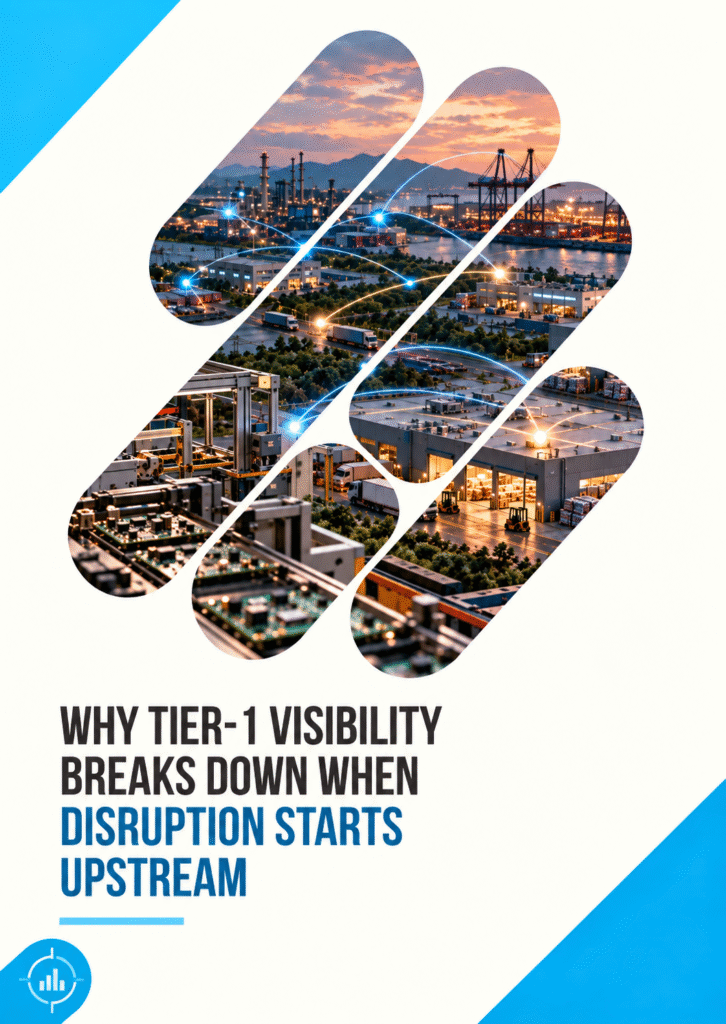
Tier-1 visibility is essential. It is also incomplete.
A company can monitor its direct suppliers closely and still discover too late that several of them depend on the same upstream producer, material, facility, or region. The direct suppliers may look independent in procurement systems. The underlying supply paths may not be.
This is why supply chain risk management is increasingly focused on N-tier intelligence: understanding the dependencies beyond direct suppliers that can determine whether disruption reaches a critical product.
Supply Chain Management Review reported in March 2026 that procurement teams are paying greater attention to Tier-2 suppliers as tariffs, volatility, and compressed launch cycles expose the limits of direct-supplier oversight.¹
The management problem is not simply a lack of data. It is the gap between seeing a supplier and understanding the business consequence of the dependency behind that supplier.
Direct-supplier monitoring remains necessary because Tier-1 suppliers sit closest to contractual performance, delivery, quality, and commercial relationships. But upstream disruption can begin outside that line of sight.
A direct supplier may depend on a specialist Tier-2 manufacturer. Several Tier-1 suppliers may share the same processor, raw-material source, port, or geography. A supplier that appears diversified may therefore carry hidden concentration below Tier 1.
Sphera’s June 2026 analysis argues that supply chain risk management is moving beyond visibility alone because organizations need to understand which signals matter and how those signals connect to business impact.²
This changes the executive question. The objective is not to map every supplier relationship. It is to identify the deeper-tier dependencies capable of affecting a critical product, service commitment, compliance obligation, or operating outcome.
A relationship graph can show that Supplier A buys from Supplier B. That is useful, but executives usually need a different answer: what does the relationship mean to the business?
A decision-ready view connects upstream entities to products, materials, sites, and supply paths. It helps reveal whether a disruption could affect a critical product and whether apparently diversified direct suppliers share the same dependency.
Academic research published in 2026 on multi-layered supplier risk assessment similarly emphasizes the need to combine multiple risk dimensions when evaluating resilience rather than rely on one supplier-level measure.³
This is the shift from supplier-centric mapping to product-centric intelligence.
If the answer is no, the organization may have visibility without enough decision context.
The distinction matters because a severe event affecting a replaceable upstream source may deserve less attention than a moderate event affecting the only approved source behind a critical product.
Do not begin by trying to map the entire supply base. Begin with business criticality.
Choose a set of products or materials where disruption would create meaningful service, revenue, compliance, or operational impact. Trace their upstream dependencies. Validate the relationships that matter most. Monitor the risk domains relevant to those nodes. Define who acts when exposure changes
CIPS reported in July 2026 that supply-chain concern remained elevated, with geopolitical disruption, inflation and input-price pressure, and cyber risk prominent in its Q2 Pulse Survey. The report also noted active redesign of supply networks in response to disruption.⁴
That environment makes prioritization important. Teams need to know which dependencies justify deeper investigation before a disruption forces the question.
| Dimension | Executive Question | Why It Matters |
| Criticality | Which products, materials, sites, and commitments cannot tolerate prolonged disruption? | Focuses deeper mapping on the areas where disruption would create the greatest business consequence. |
| Dependency | Can critical products be traced through the relevant upstream suppliers, sites, and materials? | Reveals hidden dependencies and exposure beyond Tier 1. |
| Relationship Confidence | Is each important supplier relationship verified, inferred, stale, or unknown? | Prevents uncertain or incomplete data from being treated as confirmed exposure. |
| Concentration | Do apparently independent suppliers depend on the same upstream source, geography, process, or logistics node? | Shows whether supplier diversification is genuine or whether hidden single points of failure remain. |
| Mitigation | Are alternate sources, inventory buffers, switching constraints, and response owners known? | Converts visibility into practical response options and executable action. |
| Outcome Measurement | Can leaders measure investigation time, mitigation readiness, and response performance? | Keeps N-tier intelligence tied to measurable decision value rather than data volume. |
A practical way to move beyond Tier 1 is to choose one critical product family and create a dependency brief.
The brief should list direct suppliers, known sub-tier suppliers, critical materials, production sites, relevant geographies, relationship confidence, alternate sources, inventory coverage, and expected switching lead time. It should also identify the risk signals that matter most to that supply path.
Next, run a tabletop scenario. Assume one upstream node becomes unavailable. Ask the team to identify the first affected product, the likely time to impact, the available mitigation, and the person authorized to act.
This exercise tests whether the data can support a decision.
It also reveals whether supplier diversification is genuine. If two direct suppliers rely on the same upstream producer, the sourcing model may need a different mitigation than simply adding another Tier-1 contract.
The stronger measure is whether the organization can recognize a material upstream exposure earlier and reach a defensible mitigation decision faster.
Deeper-tier visibility should be treated as a capability supporting sourcing, continuity, compliance, and risk—not as a separate mapping project.
ISM and Amazon Business reported in July 2026 that 71% of surveyed organizations said balancing cost and risk now drives procurement strategy, while 45% said they were prepared for supply-chain disruptions and 65% still relied on manual reporting to gather supply-chain data.⁵
That gap reinforces the operating challenge. N-tier intelligence becomes useful when trusted relationship data, product context, current risk signals, mitigation options, and ownership come together in one decision process.
Unlocking N-Tier Intelligence for Better Supply Chain Decisions examines how organizations can move from supplier-centric visibility toward product-centric N-tier intelligence.
The discussion focuses on hidden dependencies, concentration risk, disruption propagation, business impact, and action prioritization. For supply chain, procurement, sourcing, risk, and operations leaders, the practical question is how to identify which deeper-tier relationships matter before an upstream event becomes a direct operational problem.
Watch the on-demand webinar: Unlocking N-Tier Intelligence for Better Supply Chain Decisions.
N-tier intelligence extends visibility beyond direct suppliers to relevant upstream suppliers, sites, materials, and dependencies that can affect business outcomes.
Why is Tier-1 visibility insufficient?
Tier-1 monitoring may not reveal shared upstream sources, geographic concentration, single-source materials, or other dependencies behind direct suppliers.
It begins with a critical product or business outcome and traces the upstream dependencies supporting it, rather than treating every supplier relationship as equally important.
How should organizations start?
Start with a bounded set of critical products, validate important upstream relationships, test concentration and disruption scenarios, and define mitigation ownership.
Tier-1 visibility remains essential, but it cannot reveal every dependency that determines supply continuity.
The stronger operating model connects deeper-tier relationships to product criticality, relationship confidence, concentration, current risk, mitigation options, and accountable ownership. That allows leaders to distinguish a large network map from a decision-ready view of exposure.
The objective is not perfect visibility. It is sufficiently trusted intelligence to identify what is exposed, understand how confident the organization is, determine what can be done, and assign the next action before the response window closes.
For organizations bringing supply chain intelligence, risk, procurement, or resilience solutions to market, Intent Amplify helps translate technical capabilities into executive-ready demand generation.
Our work supports B2B technology brands with content strategy, audience intelligence, executive messaging, account-based engagement, and pipeline activation designed for complex enterprise buying cycles.
If your team is looking to engage enterprise supply chain, procurement, operations, or risk leaders with sharper market narratives and more decision-relevant content, connect with Intent Amplify.