or call: +1-602-898-6394



or call: +1-602-898-6394
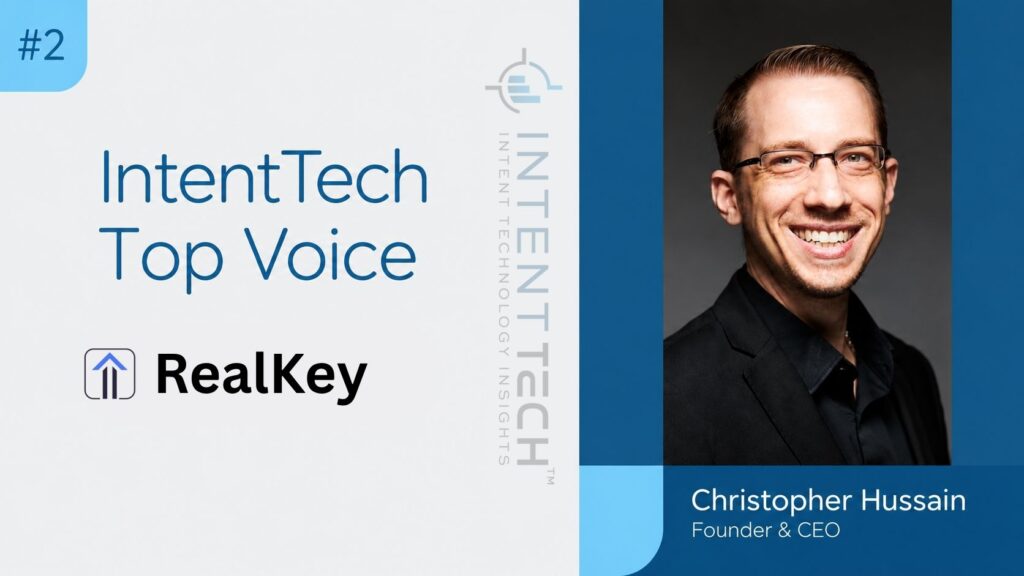
Hello, IntentTech community. Welcome to our IntentTech Top Voice interview series.
The latest IntentTech Interview with RealKey Founder Christopher Hussain is an interactive Q&A-style conversation.
Christopher Hussain is a cross-functional serial entrepreneur with two successful exits, with his most recent company, RealKey, currently paused and positioned for a potential third exit through an IP acquisition. A former #1 U.S. mortgage originator for two consecutive years, Christopher has also been recognized as one of the 15 most connected individuals in mortgage and lending and has built and scaled companies across product, GTM, operations, RevOps, and technology. His work has earned recognition from Google for Startups, NAR REACH, MassChallenge, Startup Grind Global, Alibaba Global, and other leading innovation programs and competitions.
Today, Christopher operates as a fractional C-suite executive/consultant and “one-man accelerator,” working industry-agnostically with founders and leadership teams on growth, product, GTM, fundraising, and operational scale. While fintech, proptech, and B2B SaaS remain his home base, he advises companies across industries, with companies he has worked with collectively raising more than $337M over the past 14 months.
Christopher: Usually when specialization starts creating silos.
Early on, everyone is close to the customer. The founder is selling, product is hearing feedback directly, and engineering understands why something is being built.
As the company grows, those functions naturally separate – but the information starts separating with them.
Sales knows why deals are being lost. Customer success knows why customers are frustrated. Product knows what is being requested. Engineering knows what is actually difficult to build. Marketing knows which messages are resonating. The problem is that those insights often live in five different places.
That’s when you start seeing product building things sales can’t sell, sales promising things product isn’t prioritizing, and marketing describing a product differently than customers actually experience it. The solution isn’t more meetings. It’s creating a system where information reliably moves between those teams, and everyone understands the same priorities and outcomes.
Christopher: You stop optimizing individual departments and start optimizing the customer journey.
A marketing lead isn’t valuable because marketing generated an MQL. It’s valuable if that person ultimately becomes a good customer. A product feature isn’t successful because it shipped on time. It’s successful if customers adopt it and it improves retention, revenue, efficiency, or some other meaningful outcome.
Once you think that way, the traditional departmental lines become much less important. Marketing creates demand. Sales converts it. Product delivers the value that was promised. Customer success reinforces that value. Operations and RevOps make the entire system measurable and repeatable.
Those aren’t separate engines. They’re different parts of the same engine.
Christopher: One of the biggest is when growth increasingly depends on individual heroics.
If the founder still has to rescue important deals, one salesperson owns all of the institutional knowledge, onboarding requires someone to manually explain everything, or every enterprise customer needs a completely different process, you don’t really have a scalable GTM system yet. Another sign is when nobody agrees on the numbers.
Marketing has one definition of a qualified lead, sales has another, finance has a different revenue forecast, and product is measuring engagement independently of all three. When you spend more time debating whose spreadsheet is correct than discussing what the data is telling you, the operating system hasn’t kept pace with the company.
Christopher: I’m a huge believer in automation, but I think the order matters: fix the process first, then automate it.
AI is incredibly useful when it’s eliminating repetitive work, finding patterns humans would miss, organizing unstructured information, improving personalization, or helping people make decisions faster. Where companies get into trouble is automating a broken process.
If your qualification criteria are bad, AI can qualify bad leads faster. If your customer experience is confusing, a chatbot can frustrate customers more efficiently. The goal shouldn’t be replacing people for the sake of replacing people. It should be identifying where humans create unique value and using technology to remove as much low-value work around them as possible.
Christopher: Every time the instinct is “we need another person,” I think leadership should first ask “why?”
Sometimes you absolutely need another person. But sometimes you’re hiring someone to compensate for a process that doesn’t scale, software that isn’t integrated, unclear ownership, or work that shouldn’t exist in the first place. People are expensive and complexity compounds.
A better process or piece of automation can sometimes eliminate the need for several future hires. My preference is: simplify, standardize, automate where appropriate, and then hire where human judgment, creativity, relationships, or expertise actually create leverage.
Christopher: RevOps should be connective tissue, not just the team that administers Salesforce or builds dashboards.
The real opportunity is connecting what happens before the sale with what happens afterward. Which marketing source produced the customer? What problem were they trying to solve? Which salesperson converted them? Which features do they actually use? How quickly did they reach value? Did they expand, renew, or churn?
When those datasets connect, you can answer much more important questions than “How many leads did we generate?” You can start identifying which customers you should actually be acquiring, what they value, why they stay, and where the business should invest next.
That’s where RevOps becomes strategic rather than administrative.
Christopher: That everyone knows what’s going on.
At ten people, communication happens almost automatically.
Someone hears a customer complaint, and everyone knows about it by lunch. The founder changes direction, and the whole company understands why.
At 50, 100, or 500 people, that stops working. Leaders sometimes respond by adding meetings, but meetings aren’t the same thing as alignment. You need clear ownership, documented decisions, measurable objectives, and systems that make information accessible without requiring everyone to be in the same room.
You want to preserve the speed and transparency of the early company without requiring the communication model of a ten-person startup.
To participate in our interviews, please write to our IntentTech Media Room at sales@intentamplify.com